 By admin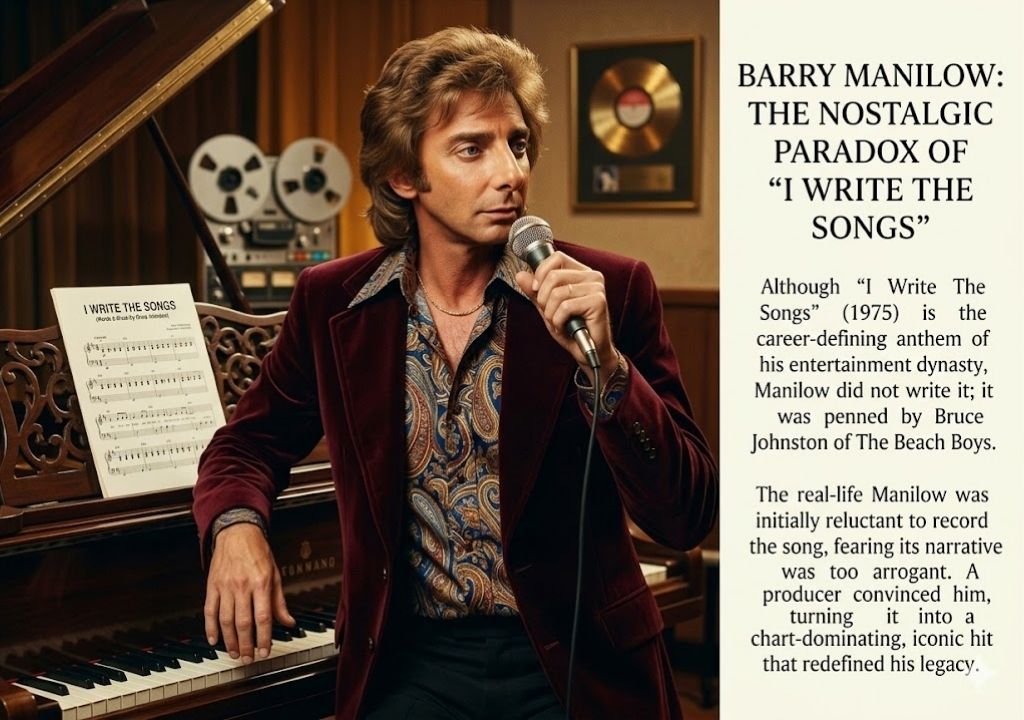
INTRODUCTION
In November 1975, Arista Records released a record that would permanently define the golden era of traditional American pop, yet its birth was mired in an extraordinary backstage irony. The track, “I Write The Songs,” quickly ascended the Billboard Hot 100, eventually capturing the number-one spot in January 1976 and generating millions of dollars in global revenue. For decades, casual listeners assumed the soaring, anthemic ballad was an autobiographical manifesto penned by the showman himself. In reality, the song was the brainwork of Bruce Johnston of The Beach Boys. This historical discrepancy forms one of the most fascinating paradoxes in entertainment history, showcasing a reluctant master interpreter who nearly walked away from the very melody that would ultimately establish his multi-million dollar entertainment empire.
THE DETAILED STORY
The journey of “I Write The Songs” from a discarded demo to a platinum-certified cultural touchstone is a masterclass in industry intuition and creative tension. When legendary producer Clive Davis first presented the track to Barry Manilow in mid-1975, the singer’s initial reaction was not one of triumph, but of profound professional apprehension. Manilow, an intensely meticulous artisan who pridefully crafted much of his own material, found the literal interpretation of the lyrics deeply problematic. He feared that singing “I write the songs that make the whole world sing” would be perceived by critics and fans as an act of intolerable artistic vanity—an ego trip that could dismantle the vulnerable, accessible persona he had carefully cultivated in show business.
What Manilow initially failed to realize, and what Davis systematically argued, was the song’s deeper allegorical architecture. Bruce Johnston had not written the lyric as a self-aggrandizing boast for a solo performer; rather, the “I” in the song was a personification of the transcendent spirit of music itself. Despite his heavy reservations, Manilow was ultimately persuaded to enter the studio, approaching the session with a determination to balance the track’s inherent grandeur with a grounded, humble vocal delivery.
The resulting recording session became a milestone in analog pop production. Manilow injected the arrangement with dramatic key changes and a sweeping orchestral backing that transformed Johnston’s minimalist concept into a majestic, towering anthem. Released as the lead single from his album Tryin’ to Get the Feeling, the track validated Davis’s commercial instincts by dominating the airwaves and securing the Grammy Award for Song of the Year in 1977. This success solidified Manilow’s status as a premier interpretive stylist. By conquering his initial reluctance, Manilow turned a potential public relations disaster into his ultimate artistic signature, forever anchoring his legacy in a beautiful contradiction.