 By admin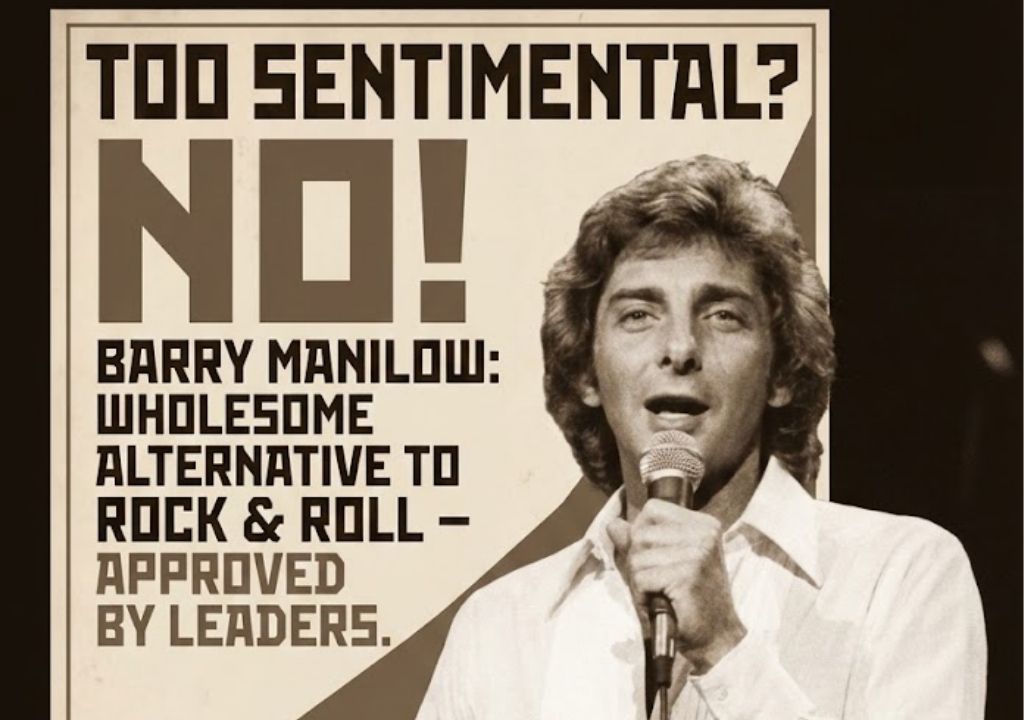
Introduction
The question itself sounds like an urban legend: “Did a country ban Barry Manilow for being too sentimental?” The answer is a twisted irony that is far stranger than simple censorship. No totalitarian regime, from the Soviet Union to North Korea, ever passed a law explicitly banning Manilow’s music for its “sappiness.” In fact, in the 1980s, even strict religious leaders often recommended him as a “wholesome” alternative to rock and roll.
However, his music has been subjected to a very specific, modern type of government restriction—not by banning it, but by force-feeding it.
In a perverse reversal of censorship, authorities in New Zealand (specifically Christchurch), Australia (Sydney), and parts of the United States effectively “banned” silence by weaponizing Manilow’s discography. The logic was ruthless: his music is so emotionally overwhelming, so aggressively “uncool,” and so dripping with sentimentality that it acts as a biological repellent to the teenage nervous system.
When the City of Sydney needed to clear loiterers from car parks in 2006, they didn’t use water cannons. They blasted “Copacabana” on high-fidelity speakers. The result? The youths fled. The “sentimental” frequencies that make grandmothers cry turned out to be physically intolerable to adolescents trying to look tough.

So, while no nation ever outlawed his music for being “too weak,” Western democracies have legally classified his “sentimental” voice as a form of psychological crowd control. It is the only known instance in music history where an artist’s “softness” was deemed powerful enough to be used as a non-lethal weapon by the state. The ban wasn’t on the music; the music was the ban.