 By admin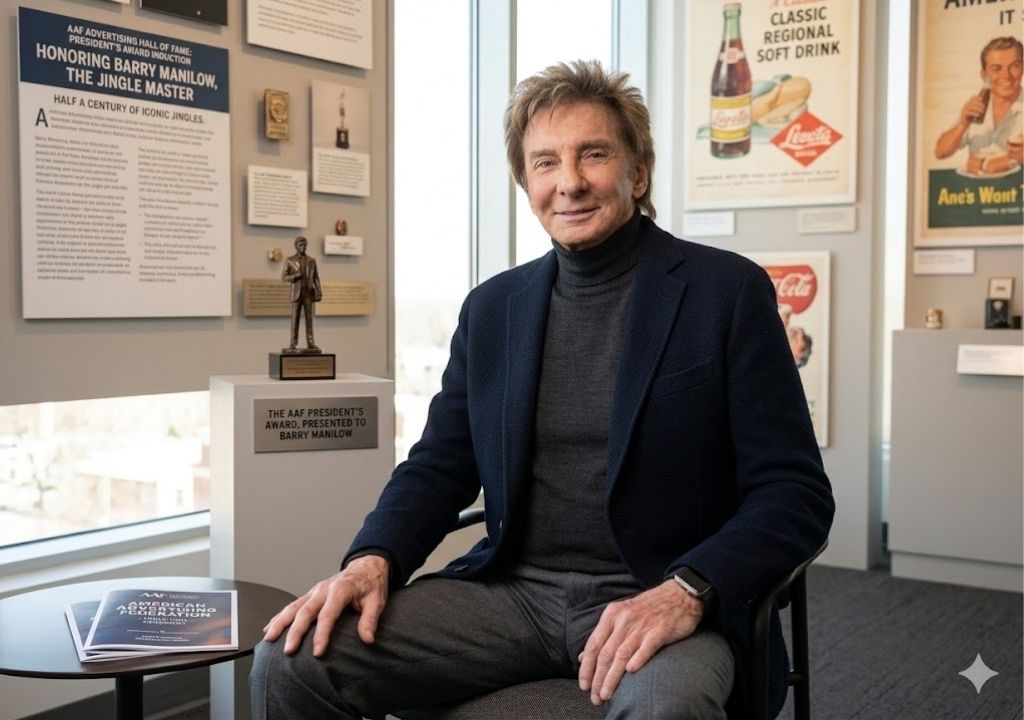
INTRODUCTION
Before he was the sequined titan of the Las Vegas Strip or the voice behind “Mandy,” Barry Manilow was the invisible ghost in the American machine. Long before the Grammys and the multi-platinum records, his melodies were already woven into the fabric of the domestic morning, the mid-day commute, and the late-night snack. Every American of a certain vintage carries a Manilow composition in their cognitive hard drive, whether they realize it or not. As the American Advertising Federation (AAF) prepares its Induction Ceremony for 04/15/2026, the spotlight shifts from his pop stardom to his foundational role as the “Jingle King.” This mid-April gala celebrates a man who understood, perhaps better than any contemporary, that a three-second hook could define a brand’s soul for half a century.
THE DETAILED STORY
The Advertising Hall of Fame has long been the sanctum of the “Mad Men” and the visionary CEOs, but this year’s presentation of the President’s Award to Barry Manilow acknowledges a different kind of genius: the melodic architect. Manilow’s tenure at agencies like J. Walter Thompson during the late 1960s and early 1970s was not merely a stepping stone; it was a masterclass in narrative efficiency. While pop songs have minutes to breathe, a jingle has mere heartbeats to establish trust, warmth, and memorability. Manilow’s contributions to the American lexicon—from the comforting assurance of “Like a good neighbor, State Farm is there” to the staccato playfulness of “I am stuck on Band-Aid”—transformed commercial interruptions into cultural touchstones.
The AAF’s decision to honor Manilow in 04/2026 reflects a growing appreciation for the intersection of high art and commercial utility. These compositions were never “disposable” art; they were precision-engineered psychological anchors. Manilow famously earned a mere $500 for some of these works, yet the equity they built for corporations is valued in the billions of USD. His ability to distill the essence of a multi-million dollar campaign into a simple piano refrain is what distinguished him from his peers. Industry insiders at Variety and Billboard have often noted that Manilow’s pop success was the direct result of this commercial discipline—the “don’t bore ’em, get to the chorus” philosophy that defined the 1970s airwaves.
As he ascends the stage in New York City this April, the temperature of the room will undoubtedly rise with the warmth of nostalgia. The President’s Award is a rare distinction, reserved for those whose influence transcends traditional advertising boundaries. For Manilow, it is a full-circle moment. It validates the “anonymous” years when his voice sold hamburgers and insurance, proving that in the hierarchy of American creativity, the jingle is the most potent form of musical poetry. This induction ensures that while the products may change, the melodies that sold them remain immortal.