 By admin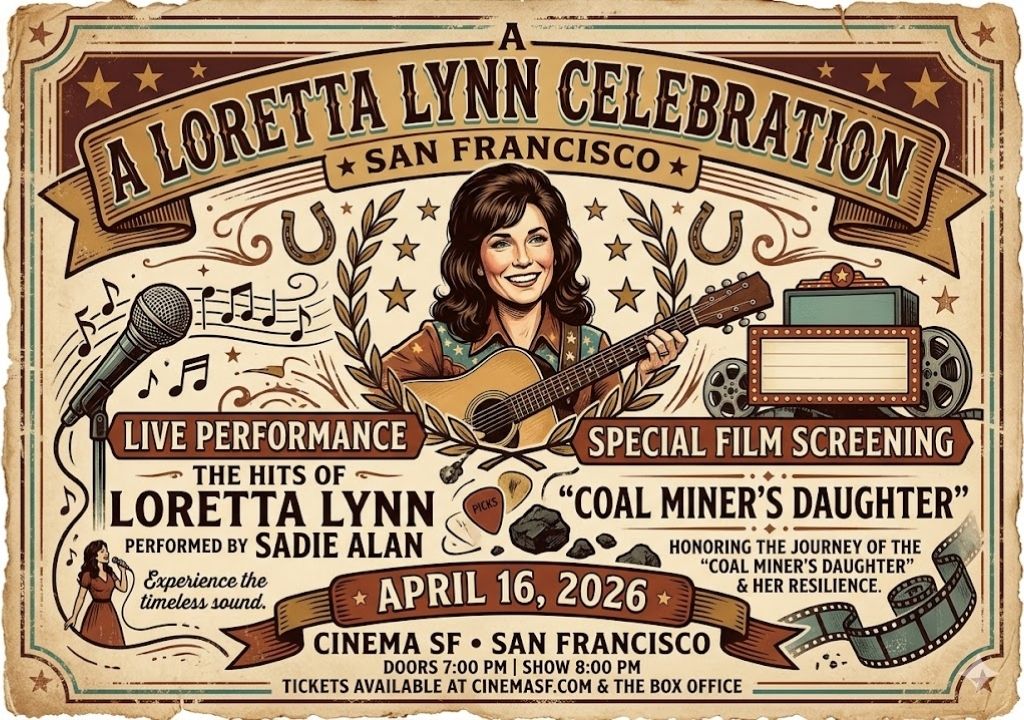
INTRODUCTION
In the heart of modern San Francisco on April 16, 2026, a specific frequency of authentic emotion will resonate, far removed from the tech corridors and Golden Gate view. This isn’t just another nostalgia show; it’s a meticulously constructed tribute to a legacy defining resilience, a celebration of Loretta Lynn, the enduring Coal Miner’s Daughter. Cinema SF will become a shrine to Appalachian grit, as artist Sadie Alan prepares to channel the raw, honest power of Lynn’s iconic hits, followed by a definitive screening of the Oscar-winning biographical film. The event serves as a crucial moment for a diverse coastal city to pause and recalibrate its understanding of American artistry, recognizing a woman whose journey from Butcher Hollow, Kentucky, to global superstardom continues to provide the master template for defiance against all odds.
THE DETAILED STORY
The true narrative power of Loretta Lynn, who passed away on October 4, 2022, transcends genre and geography. She was an agent of disruption, introducing unvarnished, often controversial honesty into the country music cannon, addressing working-class female experiences with a clarity that shocked the establishment. The Loretta Lynn Celebration is built around this central theme: resilience as art. When Sadie Alan steps onto the stage at Cinema SF, she isn’t just performing covers; she is inhabiting a spirit of defiance. Her challenge is to capture that unique combination of strength and vulnerability that made Lynn’s voice, from her first single, “I’m a Honky Tonk Girl,” in 1960, a foundational force in American popular music. This live performance, a critical component of the evening’s architecture, prepares the audience for the narrative arc to follow.
The screening of Coal Miner’s Daughter, the 1980 film based on Lynn’s best-selling 1976 autobiography, is not an afterthought; it is the event’s powerful climax. The film, directed by Michael Apted and starring Sissy Spacek in her definitive Oscar-winning role, successfully translated Lynn’s specific, localized Appalachian experience into a universal narrative of the human spirit’s triumph over extreme poverty and systemic limitation. By pairing these two elements—the live musical tribute and the iconic film—the San Francisco celebration creates a powerful, multi-sensory environment. This is a critical intervention, proving that the radical authenticity of Lynn’s story, a story where $1 meant everything and $1 million didn’t change who she was, remains a critical necessity for a society increasingly fragmented by digital facades. San Francisco, often perceived as a city focused only on future innovation, by hosting this celebration, honors the profound, unyielding truth of America’s past, and in doing so, reinforces the eternal relevance of the Coal Miner’s Daughter.