 By admin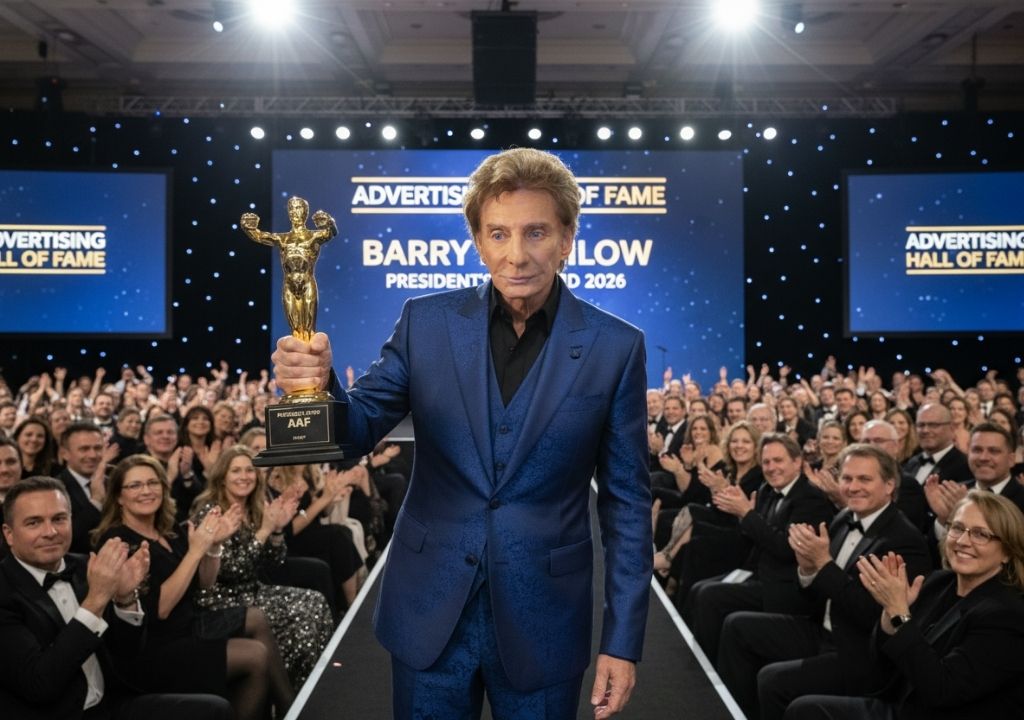
INTRODUCTION
Long before the flashbulbs of Las Vegas residencies and the global saturation of “Mandy,” a young musician sat at a piano in a cramped New York studio, tasked with a seemingly impossible challenge: distilling human comfort into a mere fifteen seconds. On April 23, 2026, the American Advertising Federation (AAF) will formally acknowledge that these brief intervals of musical genius were not merely “commercials” but the foundational architecture of modern American branding. At the Advertising Hall of Fame induction gala at Cipriani Wall Street, Manilow will receive the prestigious President’s Award, a rare distinction for a recording artist that underscores a meticulous career built on the absolute precision of a hook.
THE DETAILED STORY
The narrative of Barry Manilow is often framed as a meteoric rise to pop stardom, yet the AAF recognition refocuses the lens on his early tenure as the “Jingle King” of the 1970s. During this era, Manilow engineered the sonic identity of corporate giants, penning the ubiquitous “Like a good neighbor, State Farm is there” and the percussive, childlike rhythm of “I am stuck on Band-Aid brand, ’cause Band-Aid’s stuck on me.” While he famously received a flat fee of just $500 for the State Farm composition—forgoing the residuals that would have likely equated to millions of USD—the cultural dividend has proven immeasurable. These melodies did not just sell insurance or adhesive strips; they successfully infiltrated the American psyche, proving that a sophisticated arrangement could make a corporate entity feel like a trusted companion.

The President’s Award is a discretionary honor, reserved for figures whose primary careers lie outside advertising but whose creative output has fundamentally shifted the industry’s paradigm. Manilow’s contribution lies in his unique ability to marry emotional resonance with commercial utility. His work for McDonald’s, where he served as the voice behind “You Deserve a Break Today,” demonstrated a nuanced understanding of consumer psychology—that a song could offer a temporary sanctuary in an increasingly chaotic world. Even as he transitioned into a Grammy-winning superstar, Manilow never discarded these early lessons in brevity and connection, often performing a medley of his commercial hits during live shows to the thunderous approval of audiences who still know every syllable.
As the industry prepares to gather in New York this April, the discussion surrounding Manilow’s legacy has evolved into a study of artistic integrity within the commercial sphere. The AAF’s tribute confirms that there is no hierarchy in high-quality composition; whether a piece is a three-minute ballad or a thirty-second jingle for Pepsi, the requirement for excellence remains inevitable. Manilow’s upcoming induction is a full-circle moment that validates his belief that a great song, regardless of its length or purpose, is a permanent gift to the culture. The question remains: as we enter an age of algorithmic marketing, will we ever again witness a single melody with the power to unite an entire nation’s memory?