 By admin

Introduction
This is not just a tour; it is an invitation into the inner sanctum of the man who invented the concept of “Cool.”
As a veteran journalist who has covered the pulse of American culture for decades, I’ve seen many icons, but none command a room—or a vault—quite like Elvis Presley. I recently sat down with Angie Marchese, the Vice President of Archives at Graceland, to go beyond the gates and into the fabric of a legend.
Here is the secret history of the wardrobe that didn’t just dress a star—it defined an era.
The Original Influencer
Long before “influencer” was a job title, Elvis was the blueprint. Even as a teenager in Memphis, he was a rebel with a cause: style. He flipped his collars to hide his neck and wore pink when society said he shouldn’t. By the time he hit the stage in the 1950s, his fashion was as edgy as his music.
Take the Nudie’s of Hollywood Gold Suit. This wasn’t just clothing; it was a psychological weapon. Colonel Parker, Elvis’s legendary manager, turned the suit into a marketing masterclass. The gold suit would arrive in an armored car on the day of the show to drum up press and ticket sales. Elvis, ever the practical performer, often only wore the jacket because the full suit was “insanely hot,” but the flash of that gold under the spotlights became the first great image of Rock ‘n’ Roll.
From Leather to the Legend of the Jumpsuit
The 1968 Comeback Special was the pivot point. Out went the Hollywood fluff, and in came the black leather two-piece designed by Bill Belew. It set a new tone of raw, masculine energy that paved the way for the Las Vegas residency era.
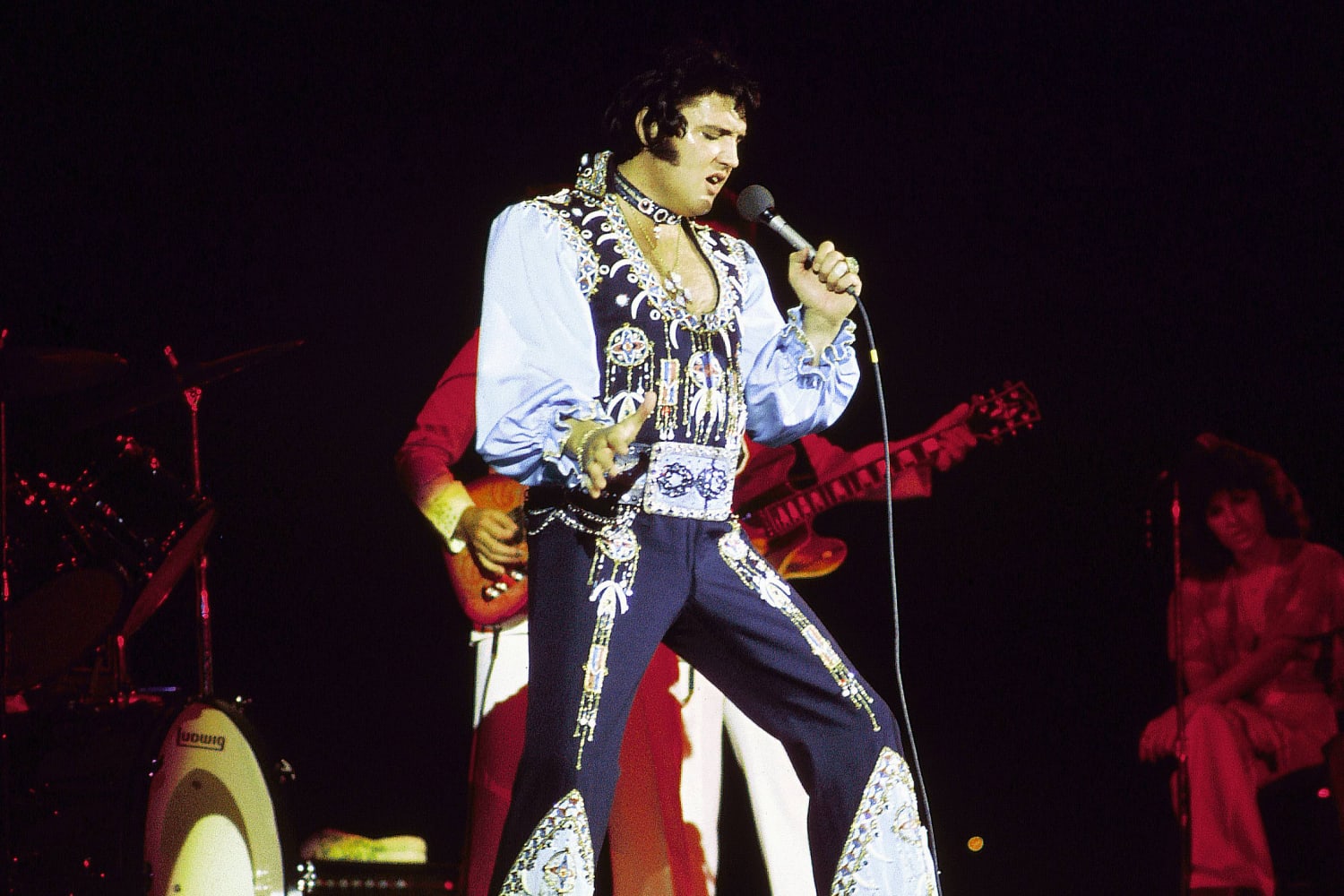
But did you know the iconic jumpsuit was born out of a wardrobe malfunction? Elvis’s stage movements were so aggressive that he kept ripping his pants. Belew’s solution? Merge the tunic and trousers into a one-piece masterpiece. These weren’t just costumes; they were “Armor in Wool Gabardine,” lined in silk and heavy with beading. From the “Purple Owl” to the “Firework,” each suit had its own personality and a nickname to match.
The American Eagle: A Message to the World
The pinnacle of the collection is undoubtedly the American Eagle suit from the 1973 Aloha from Hawaii special. With 40 nations watching via satellite, Elvis wanted to wear something that represented his country. He rejected a map of the U.S. and a flag, choosing instead the national bird in a red, white, and blue motif.
In a moment of pure rock-and-roll theater, Elvis tossed the original cape and belt into the crowd. Today, thanks to the meticulous work of Marchese’s team, all three versions of that legendary cape—including the one thrown to a lucky fan—are back home at Graceland.
The Resurrection

The legacy came full circle with Baz Luhrmann’s 2022 ELVIS. Costume designer Katherine Martin spent five years in the Graceland archives, ensuring every stitch on Austin Butler was authentic. From the Crown Electric truck-driver uniform to the 90 different outfits featured in the film, the attention to detail was forensic.
To walk through the “Dress to Rock” exhibition is to see a man who fulfilled a childhood promise to buy his parents a big house and ended up building a temple to American style. Elvis may have left the building, but his wardrobe is still very much the King.