 By admin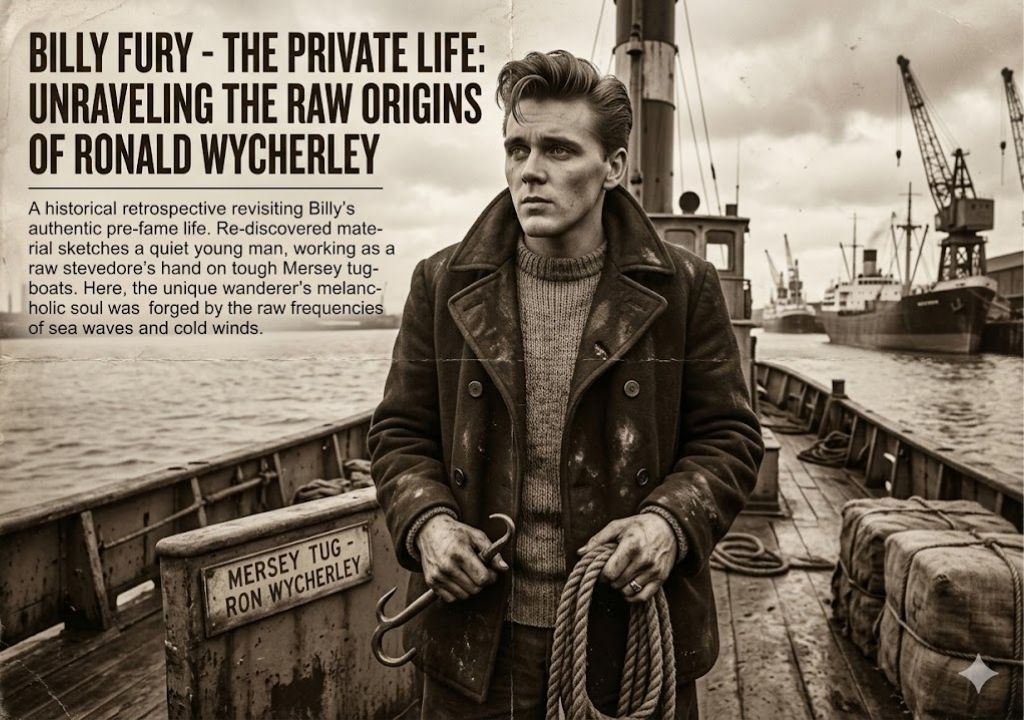
INTRODUCTION
The biting winter wind off the River Mersey in the mid-1950s carried more than just the scent of saltwater and diesel; it carried the unspoken dreams of a fragile teenager named Ronald Wycherley. Long before he would capture the hearts of millions under the stage name Billy Fury, Wycherley lived a remarkably grounded, industrial existence in Liverpool. Working as a deckhand and stevedore on local tugboats, the young man spent his formative years hauling heavy cargo against a backdrop of gray skies and churning water. This harsh, unvarnished environment did not harden him; instead, the rhythmic crashing of the waves and the isolation of the docks nurtured a profound, introspective melancholy. Retrospective historical archives now illuminate this raw, pre-fame chapter, revealing how the relentless elements of the English coastline permanently sculpted the soulful vulnerability that would later revolutionize mid-century popular music.
THE DETAILED STORY
To understand the magnetic gravity of Billy Fury’s stage presence, one must look beyond the polished aesthetics of the music industry and return to the rugged topography of the Liverpool docks. Born into a working-class family, Ronald Wycherley faced severe health challenges from early childhood, including rheumatic fever which permanently damaged his heart. Despite his physical fragility, economic necessity compelled him to seek employment in one of the most demanding sectors of post-war Britain. As an assistant stevedore on the River Mersey, his daily life was defined by grueling physical labor, shifting heavy crates, and navigating the treacherous, icy currents of the river.
Yet, historical retrospectives indicate that this demanding environment served as an unconventional sanctuary for his developing creative consciousness. Away from the clamor of the urban center, the vast expanse of the Mersey provided a unique sonic canvas. The steady cadence of chugging tugboat engines, the haunting wail of distant foghorns, and the expansive silence of the open water resonated deeply with the young worker. Wycherley used these solitary hours to internalize the rhythms of American country and rockabilly music that arrived via sailors on transatlantic ships, quietly synthesizing these influences with his own deep-seated emotional sensitivity.
This juxtaposition of rugged manual labor and innate tenderness forged the exact artistic dichotomy that impresario Larry Parnes would discover in 1958. When Wycherley transitioned into Billy Fury, he brought an authentic, weathered depth to the stage that his peers simply could not replicate. He was not merely performing sorrow; he had lived it amidst the cold spray of the Mersey. By examining these raw beginnings, cultural historians underscore a vital truth: Fury’s legendary status was not manufactured in a studio, but rather hammered out in the quiet, industrial spaces of his youth, proving that true artistry often emerges from the most unyielding soils.