 By admin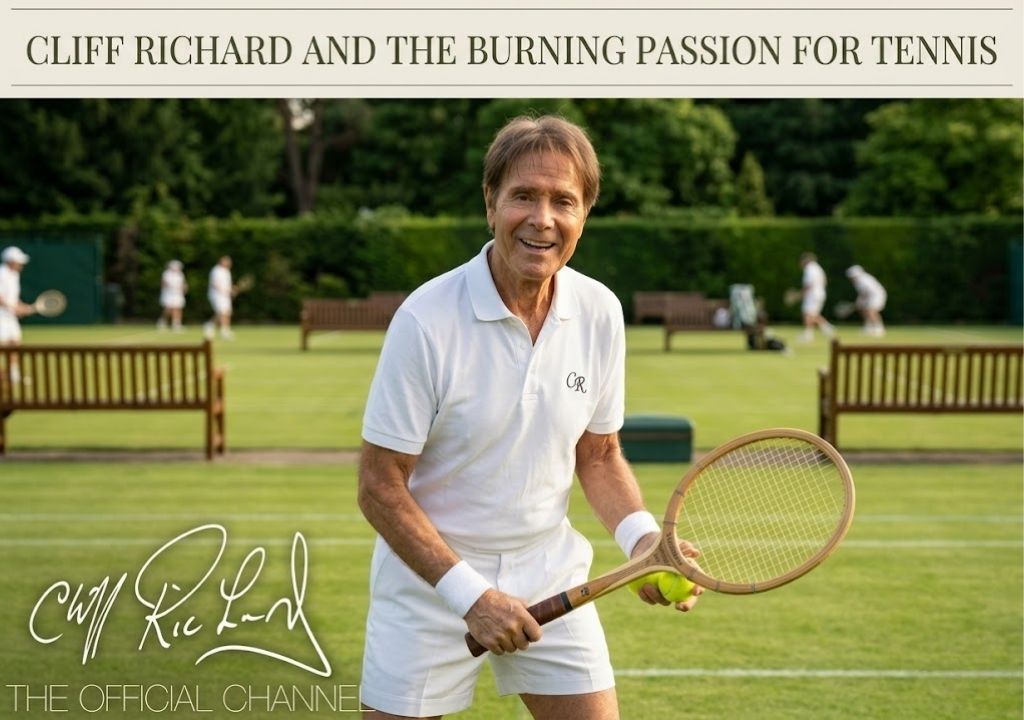
INTRODUCTION
On July 03, 1996, the Centre Court at Wimbledon was paralyzed by a characteristic English downpour. As the world’s elite athletes retreated, Sir Cliff Richard stepped into the void, transforming a somber rain delay into an impromptu masterclass of charisma. While his rendition of “Summer Holiday” became a historic cultural artifact, it merely scratched the surface of a deep-seated obsession. For Richard, tennis is not a peripheral hobby but a central organizing principle. This devotion extends far beyond the prestige of the Royal Box; it is found in the relentless, rhythmic geometry of the clay and grass courts he has frequented for over five decades. This athletic pursuit represents a deliberate intersection of physical rigor and mental clarity, serving as the silent engine behind one of the most enduring legacies in Western entertainment history.
THE DETAILED STORY
The architecture of Sir Cliff Richard’s life is defined by a refusal to succumb to the traditional entropy of age, and tennis is the primary instrument of this resistance. Established with the precision of a professional athlete, his daily regimen often centers on the court, regardless of whether he is in Barbados, Portugal, or the United Kingdom. This is not merely recreational; it is a calculated discipline. In 1991, he formalized this passion through the Cliff Richard Tennis Foundation, an initiative designed to democratize the sport for primary school children. By investing millions of USD ($) into grassroots coaching, Richard sought to instill the same structural benefits he extracted from the game: focus, endurance, and the strategic anticipation of an opponent’s next move.
His relationship with the sport mirrors the meticulous nature of his music career. Just as he navigated the shifting tides of the Billboard and UK charts, Richard treats the baseline as a site of constant calibration. He is often seen at Wimbledon, not just as a celebrity spectator but as a technical observer, maintaining close ties with icons like Virginia Wade and Martina Navratilova. His fitness, frequently remarked upon by the press when temperatures on court soar above 90°F, is a direct byproduct of this sustained athletic engagement. In an industry where the narrative of the aging star is often one of decline, Richard utilizes the court to project a counter-narrative of perpetual motion.
The tennis court serves as a laboratory for his longevity. It provides a sanctuary of intense focus where the pressures of global fame are replaced by the singular, unyielding physics of the ball. For Richard, the game is a metaphor for a career that has spanned the development of modern pop: it requires a mastery of the fundamental serve followed by the agility to adapt to every return. Through this lens, his burning passion is revealed as a sophisticated strategy for self-preservation, ensuring that both the man and the artist remain in peak competitive form.