 By admin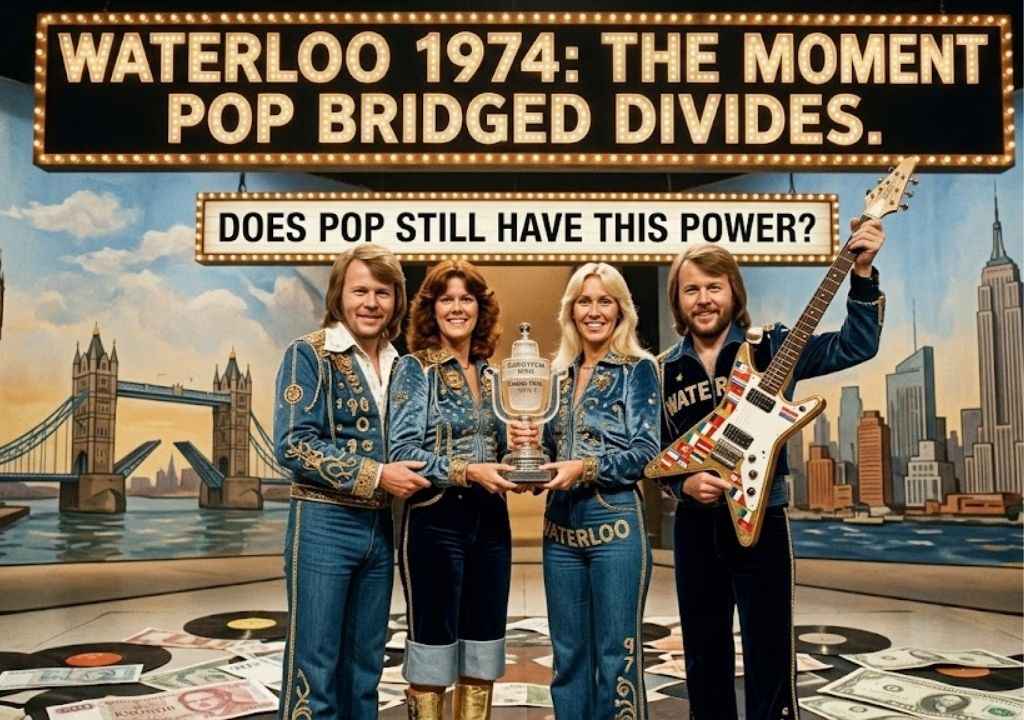
INTRODUCTION
On the evening of 04/06/1974, the Brighton Dome in the United Kingdom bore witness to a seismic shift in musical history. As conductor Sven-Olof Walldoff took his place dressed as Napoleon Bonaparte, the audience sensed that this was no ordinary Eurovision entry. Within three minutes, the quartet—Agnetha, Björn, Benny, and Anni-Frid—shattered the contest’s tradition of safe ballads. Adorned in silver platform boots and glittering blue velvet, they delivered “Waterloo” with a glam-rock vigor that felt more like a revolution than a competition entry. It was the precise moment when Swedish pop shed its regional constraints to become a universal language. The song did not just win the contest; it declared the arrival of a production powerhouse that would eventually sell over 380 million albums. This was not merely a performance; it was the coronation of a pop dynasty.
THE DETAILED STORY
The success of “Waterloo” was no accident; it was a masterclass in strategic musical architecture. While Eurovision was historically characterized by “chanson” style melodies and linguistic regionalism, ABBA and their manager, Stig Anderson, made the calculated decision to perform in English. This maneuver was designed specifically to bypass the limitations of the Swedish market and target the lucrative territories of the United Kingdom and the United States. Following their victory, “Waterloo” surged across the Atlantic, peaking at #6 on the Billboard Hot 100 in August 1974—a rare feat for a non-English-speaking group at the time.
The track itself represented a sophisticated synthesis of influences. Benny Andersson and Björn Ulvaeus utilized a “Wall of Sound” production technique, layering vocals and instruments to create a dense, resonant texture that sounded as powerful on a transistor radio as it did in a concert hall. The lyrics cleverly employed the historical defeat of Napoleon as a metaphor for romantic surrender, a narrative choice that was both accessible and conceptually sharp. The single generated millions in USD across international markets, topping the charts in West Germany, South Africa, and Australia, proving that their appeal was truly global.
Beyond the immediate financial and chart metrics, “Waterloo” fundamentally altered the DNA of the music industry. It established the “Swedish Model” of songwriting—characterized by mathematically precise melodies and impeccable production standards—which would later influence everyone from Max Martin to contemporary pop icons. The song served as a blueprint for how a small-nation act could achieve total cultural hegemony through sheer technical excellence and aesthetic audacity. Even decades later, the resonance of that night in Brighton remains palpable. The 1974 victory remains the gold standard for breakthrough performances, a reminder that in the world of high-stakes pop, a single three-minute window can indeed change the world. The legacy of “Waterloo” is not found in the nostalgia of its costumes, but in the enduring perfection of its structure.